Kerb to Road Test: What Really Happens When a Mobile Clutch Fitter Pulls Up Outside Your House
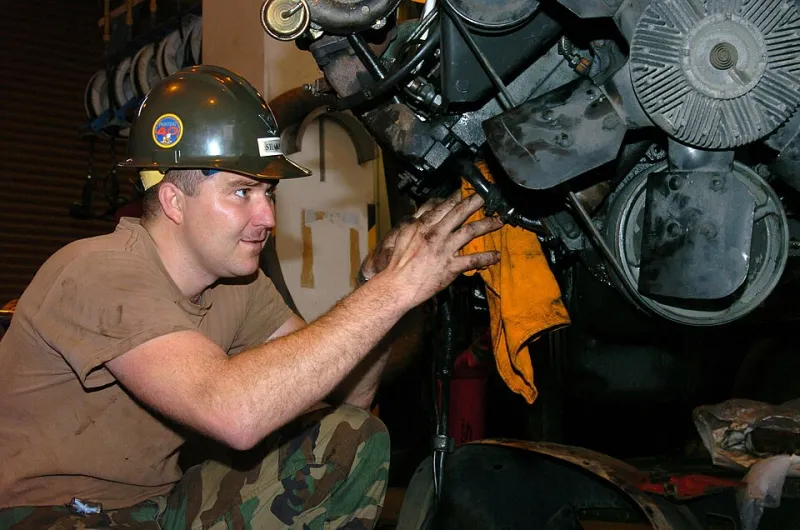
Photo: U.S. Navy photo by Photographer's Mate 3rd Class John P. Curtis, Public domain, via Wikimedia Commons
If you've only ever dealt with a clutch through a garage reception desk — handing over keys, waiting for a phone call, gulping at the invoice — the idea of the whole job happening on your own drive can feel slightly unreal. Who does it? How long do they need? And do they genuinely get a gearbox out on a residential street in Sheffield or Swindon without drama?
The short answer is yes, usually. The longer answer is worth reading, because a mobile clutch change has its own rhythm, its own limits and a few things you can do to make it go smoothly.
First, the arrival and the five-minute chat
A decent mobile fitter turns up in a van that looks like a workshop on wheels — trolley jacks, axle stands, a clutch alignment tool, a hydraulic bleeder, brake cleaner, gloves, the lot. Before anything gets lifted, there's a conversation: confirm the vehicle, confirm the symptoms, confirm the price quoted on the phone still stands.
That chat matters more than it sounds. Clutch noises are easy to misdiagnose over the phone. A rattle at idle that vanishes when you press the pedal might be a release bearing, or it might be a dual-mass flywheel on its way out — and that changes both the parts list and the final bill. A good fitter will want to hear it cold, before the engine has had a chance to warm up and mask anything.
The safety check nobody advertises
Here's the part that separates a proper operator from a chancer. Clutch work means crawling under a car, and that means the car has to be genuinely secure. Expect to see the ground assessed for slope and surface, the handbrake checked, wheels chocked, and the jacking points inspected for rot before a trolley jack goes anywhere near them.
If your drive is on a noticeable gradient, made of loose gravel, or the car is sitting on a soft verge, a responsible fitter may call it off or ask you to move the car somewhere flatter. That's not fussiness. A clutch replacement involves levering, pulling driveshafts and occasionally a bit of persuasion with a long bar — you do not want that happening on an unstable surface.
Older cars with tired sills and corroded jacking points are another common stop sign. Better to hear that at 8am than to find out halfway through.
Jacking up and taking things apart
Once the car is up on stands, the shape of the job depends entirely on the layout. On a transverse-engined hatchback, the gearbox usually comes out from underneath — driveshafts disconnected, battery and tray out of the way, mounting bolts released. On some rear-wheel-drive motors, it's a different routine altogether.
Timings vary hugely. A straightforward front-wheel-drive hatch might take two to three hours. Something with a dual-mass flywheel, a concentric slave cylinder buried inside the bellhousing, or stubborn fourteen-year-old bolts can stretch to five. Fitters generally know which category your car falls into before they arrive, which is why a quote over the phone should always be given as a range rather than a hard number.
The bit most drivers never see: old versus new
This is the genuinely useful part, and it's where a mobile job beats a garage desk. Most fitters will happily show you the old clutch once it's out. You'll see the friction plate — if the lining is down to the rivets, that's your slipping sorted. You might see blue heat spots on the flywheel face, or a shiny glaze from a lot of town driving. You may see oil contamination, which points to a leaking rear main seal and needs addressing before the new clutch goes in, or you'll be back in the same position in six months.
Ask them to check the flywheel play while it's exposed. Dual-mass flywheels are the single biggest reason a 'cheap' clutch quote balloons on the day, and it's far better to have that conversation with the gearbox already off than to book a second visit.
Reassembly, bleeding and the road test
Putting it back together is the quiet, methodical half of the job. New release bearing, clutch aligned, gearbox mated back up, driveshafts refitted, mounts torqued. Then the hydraulics get bled so the pedal feels right — a spongy pedal after a clutch change almost always means air in the system.
Then comes the road test. Not a lap of the block for show, but a proper check: bite point position, clean selection through every gear, no crunch into reverse, no judder pulling away, no slip under load on a hill. If something's off, it's much easier to sort now than after the van has gone.
What to have ready before they arrive
- Space. Roughly a car and a half's worth of clear, flat ground, with room for the van alongside.
- Permission. If you're in a flat or renting, check with the landlord or freeholder first. On-street jobs in permit zones are often a non-starter.
- The car's history. Any recent clutch work, known leaks or warning lights are worth mentioning upfront.
- A note of the symptoms. When it slips, when it rattles, whether the pedal has gone soft or heavy.
- Patience, not hovering. Fitters are generally happy to chat, but a running commentary slows the job down.
Paperwork, warranty and the first few hundred miles
Ask about the warranty before booking, not after. A reasonable mobile clutch warranty is twelve months or twelve thousand miles on parts and labour, and it should be in writing. Keep the receipt — it's your proof if anything goes wrong.
For the first few hundred miles, treat the new clutch kindly. Avoid dumping it at the lights, don't tow anything heavy, and don't rest your foot on the pedal between gear changes. If you notice juddering that doesn't settle after a week or two, ring it in rather than living with it.
When a driveway isn't the right place
Mobile fitting suits most ordinary clutch replacements, but not all. Seized or rounded bolts, subframe drop work, a suspected gearbox fault rather than a clutch fault, or genuinely grim weather can all push a job into a workshop. A fitter who tells you that honestly on the phone is a fitter worth using.